- Biblical Maps
- Home Page
- History of Israel Blog
- Ancient Mesopotamia
- Map of Palestine
- Abraham
- Ancient Israel
- 12 Tribes of Israel
- Jerusalem
- The Book of Isaiah
- Palestine
- The Habiru
- Contact Us
- Bible Study Forums
- Media Page
- Visitors Sitemap
- Privacy Policy
- The History of the Old Testament
- In the Days of Noah
- The City of Jericho
VISIT OUR FACEBOOK PAGE!
Ancient Egyptian Literature
Ancient Egyptian Literature (1470 B.C.E. - 1140 B.C.E.)
Ancient Egyptian literature bears mention of a specific group of people designated as PR.W. This is pronounced, "Apiru'. Scholars were quick to notice similarities between 'Apiru', and the terms Habiru and Hebrew. Indeed, the word Apiru oftentimes refers to a similar type of people as Habiru. Apiru in the Egyptian texts are often depicted in manual labor, a parallel of the Hebrews in ancient Egyptian history.
Scholars agree that the PR.W logogram finds its Akkadian equivalent in Hapiru. The reference to the Apiru in ancient Egyptian literature is simply a different name for the same group of people know elsewhere as Habiru.
A scene from the tomb of an Egyptian woman dating from 1470 B.C.E. depicts a group of men working at a wine press. The caption of the scene reads;
"Straining out wine by the Apiru."
The date of this scene puts it during the reign of Hatshepsut
and Thutmose III. It is noteworthy this scene depicts foreigners doing
manual labor in Egypt - a condition that accurately described Israel's slavery experience. From these references it would appear the ancient Egyptian economy relied heavily on the menial labor tasks assigned the Apiru. This, too, is in accordance with Egypt's reliance upon Israelite slave labor in the Old Testament.
Another document has been found dating from 1440 B.C.E. This document, also from the reign of Thutmose III, is from the Pharaoh's general, General Toth, and speaks of the conquest of Joppa. The General asks that the horses of he and his men be taken inside the city, lest they be stolen by "passing Apir".
The phrase, "passing Apir" implies a migrating band, certainly
not out of character of the Habiru (and Israelites/Hebrews) based on numerous previous references. Linguists
take notice of the word used as "Apir" without the typical -u ending. Apir, in this sense, is closely related to Iber/Eber. A linguistic similarity can be made between the Apiru/Habiru, and the
Hebrew. One of Abraham's descendants was named Eber.
|
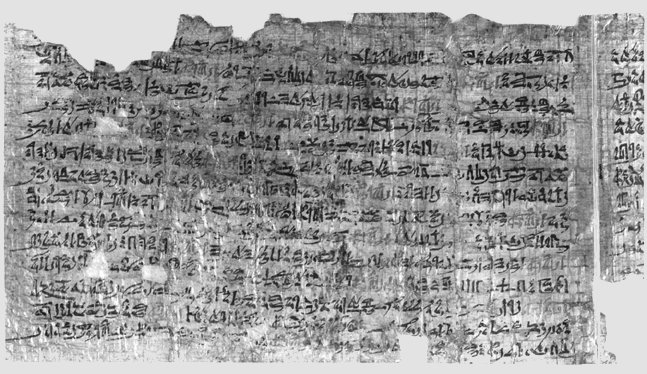
THE IPUWER PAPYRUS |
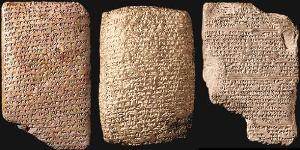
THE AMARNA TABLETS |
|
THE BOOK OF ENOCH |
THE BOOK OF ENOCH |
The linguistic similarity noted here, as well as the common depictions of the Apiru involved in manual labor, is compelling evidence these people could have been the Hebrews during their stay in Egypt. Oftentimes in antiquity if a ruler wanted to memorialize a battle, or victory, or a eulogy on a headstone, they would erect stone or granite slabs with inscriptions on them. These slabs were called steles. Much knowledge of ancient Egyptian literature and history has been taken from steles.
Inscriptions from the reign of Amenhotep II have been found on a stele in Memphis. The stele dates from 1420 B.C.E. It is a list of spoils from his Syrian campaign. Apiru are mentioned as being taken captive and brought back to Egypt.
"List of the plunder which his majesty carried off. Princes of Retenu (Syria): 127Brothers of princes: 179Apiru: 3600Shasu (Bedouin): 16,200 Khuru (Hurrians) : 26,300 Neges (Nuhashians): 15,070"
Some scholars have pointed out the list descends in social order,
from highest class to lowest class. The Apir seem to represent some
form of middle class in this hierarchy. They rank below royalty, yet
above the remaining people.
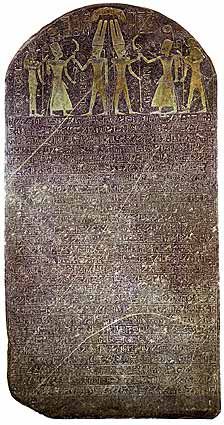
A particularly interesting stele is found in Beth-shan, the work of Set I during a campaign in Palestine around 1300 B.C.E. The stele describes a military engagement among local tribes. It dates from the time of the Amarna letters and speaks of similar circumstances - marauding invaders.
"This day, then, one came to tell his majesty that the Apiru of Mt. Yarmut, together with the Tayaru...are engaged in attacking the Asiatic nomads of Ruhma."
The Apiru were engaged in open warfare in the hill country of Canaan. The Amarna letters , dating from the same period, also speak of Habiru attackers raiding towns and sometimes seizing control of cities throughout all of Canaan. One Egyptian vassal was said to have handed Shechem over to the Habiru.
Shechem is one of the major cities located in the hill country of Western Canaan - territory that would become Israel's heartland.
Shechem and Jerusalem were the two earliest capitals of Israel. Could these steles and the Amarna Letters record the earliest invasions of Israel and settlement in Canaan by Joshua and the other tribes of Israel?
A parallel situation is described in the Old Testament books of
Joshua and Judges, though the dates of these books are in dispute. These two books record the Israelite Conquest and subsequent Settlement of Canaan by the Twelve Tribes of Israel under Joshua's leadership.
Some scholars place the events described in Joshua and Judges to the same time as the Amarna Letters. The different sources speak of similar circumstances, events and players - though using different names to describe each. Archaeology has proven futile in trying to sort out the details - with opposing views raging in debate.
The Apiru in the hill country do parallel the situation described in the Amarna Letters. These two references from different sources indicate Egypt's control was waning. The Apiru, like the Hebrews, were engaged in manual labor in one text; and warfare in Canaan in the other.
From an inscription dating from the reign of Seti I we learn a number of Apiru men are taken captive and shipped back to Egypt as slaves. The son of Seti I is Ramses II. Many feel Ramses II is the most likely candidate to be the Pharaoh of the Exodus. Apiru were in existence for a stretch of at least three hundred years in Egypt. It is evident slaves were regularly shipped back to Egypt, thus, at some point the slave population would indeed grow to be quite numerous. The Bible does depict the Hebrews as multiplying at rapid rates during its slavery in Egypt.
ANCIENT EGYPTIAN LITERATURE
The Ipuwer Papyrus (1250 B.C.)
In the early 1800's a remarkable discovery in the field of ancient Egyptian literature was made. A collection of ancient Egyptian papyrus scrolls were unearthed.
One papyrus in particular was interesting. This scroll dated from the reign of Ramses II, around 1250 B.C.E. A papyrus known as the Ipuwer Papyrus, or officially, Admonitions of an Egyptian from a hieratic papyrus in Leiden, is the sole existing copy of an earlier manuscript. The original work's antiquity is debated, but many believe it dates from between 1800 - -1650 B.C.E.
THE IPUWER PAPYRUS SPEAKS OF NATURAL DISASTERS OCCURRING IN EGYPT. THESE DISASTERS ARE STRIKINGLY SIMILAR TO THE PLAGUES IN EXODUS, PROMPTING MANY TO CONCLUDE THIS IS AN EYEWITNESS ACCOUNT OF THOSE EVENTS THROUGH THE EYES OF AN EGYPTIAN PRIEST.
The Ipuwer Papyrus is an Egyptian poem written by an Egyptian named Ipuwer. This poem describes an Egyptian Empire in a state of total chaos. Natural disasters have crushed the Egyptian spirit. Famines and plagues are said to have taken the lives of many people. One statement makes mention of a, "..River of blood...". One major cause for the upheaval is the servants have openly rebelled and are leaving Egypt.
Many passages from this papyrus mirror the Exodus account of the plagues and Israelites exit from Egypt. The obvious assumption made by many was this account represented outside evidence supporting the Exodus of the Hebrews out of Egypt, and the plagues that accompanied Moses and his dealings with Pharaoh. Many feel this is an eyewitness account of the event through the eyes of Ipuwer.
Egyptologists, not surprisingly, were quick to down play such theories In any case, a reference to the Apiru was identified in the papyrus'. The Apiru, thus, have drawn close parallels to the Hebrews.
"Issue grain to the men of the army and to the Apiru who draw stone for the great pylon of Ramses II"
The Apiru are being used as quarry men and manual laborers. Such tasks were typically reserved for the slave population of Egypt. Two more references to the Apiru are found in ancient Egyptian literature, whereas after 1000 B.C.E. no more references can be traced.
One of these references from ancient Egyptian literature has been dated from 1170 - 1160 B.C.E., the reign of Ramses III. A list of goods are said to have been dedicated by the Pharaoh to the temple of Atum, including "Apiru".
The last reference dates to 1140 B.C.E. The document is from Ramses IV, and is a a list of men sent to the quarry in Wadi-Hammamat. Among the men sent are, "800 Apiru".
These references from ancient Egyptian literature show a class of people attempting to sustain themselves by any means necessary.
They are often engaged in tasks reserved for slaves, yet, they are not called slaves in any of the literature. Instead, they appear a notch above the local Bedouin and other fringe groups. There are many similarities between them and the Hebrews of the Old Testament.
They are engaged in manual labor at all levels of society, from making wine to working in the quarry. They are engaged in military affairs, both in the service of Egypt, and as a separate group waging its own war in the hill country. The Apiru, like the Hebrews, were a diverse group of people.
In conclusion, ancient Egyptian literature dealt with the Apiru/Habiru on multiple levels; from the various papyrus scrolls discovered, covering the whole of ancient Egyptian literature, to the specific and frequent mention in the Amarna Letters, ancient Egypt interacted frequently, and intimately with the Apiru/Habiru.
This is yet another connection to the Hebrews, who also shared an intimate history with ancient Egypt.
SHARE YOUR THOUGHTS ON THE HABIRU & ANCIENT EGYPTIAN LITERATURE. Are you a student of Egyptian history? Have you studied the Habiru? Who do you think these people were? Click on the above link to give us your insights, thoughts, comments, and questions!
Additional Resources
Ancient Egyptian Literature - worldhistory.org
Back to Ancient Egyptian Literature
Back to the Habiru
Back to Home Page

SAMUEL the SEER
Now Available in Print & eBook on Amazon!!

POPULAR TOPICS
Learn more about these popular topics below. The Bible is full of fascinating stories, characters and mysteries!
BIBLE MAPS
Explore the land of the Old Testament! View these maps of the Bible.


)

